
Where Brits are learning about personal finance
29 min read
The way people learn about money is changing. For generations, people have learnt about personal finance from those closest to them, such as their parents, partners and peers, or conventional sources of knowledge on the topic, like banks. But as technology becomes ever more present in our daily lives, a new source of guidance is rapidly entering the picture: Artificial Intelligence.
In a comprehensive survey of 2,000 UK adults, Capital One UK (opens in a new tab) explored this evolving landscape and uncovered a significant shift: AI tools are now a more common source of lifelong financial learning than schools, and among our most common sources for day-to-day advice.
At Capital One UK, we want to help people succeed with credit. So, we've looked into who is using AI for help with their personal finances, along with how and why they're using it, so we can share our top tips for safely navigating this new digital tool.
Key findings
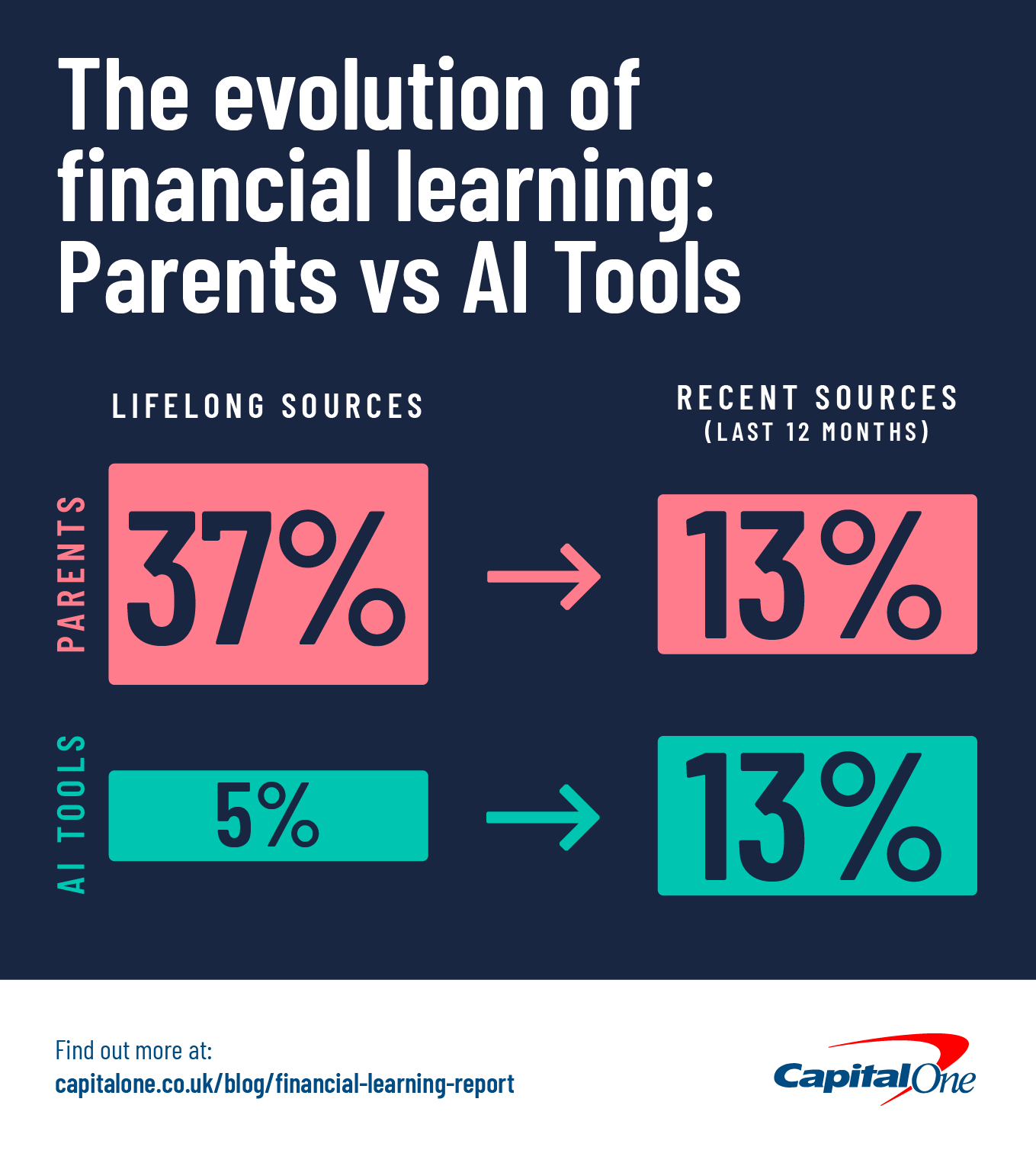
Over our lifetime, our parents teach us the most about money: Parents (37%) are the primary source for lifelong learning about personal finances, followed by banks / financial institutions (31%) and search engines (19%).
But today, people are as likely to ask AI for help with their finances as their parents: 1 in 8 people (13%) said they had asked an AI tool for help with their personal finances in the last year - the same as those who turned to their parents.
Millennials are the biggest AI adopters: 1 in 5 (22%) Millennials have used AI for help with their personal finances in the last year (ahead of Gen Z at 15%), while 1 in 10 (9%) Millennials cite AI as one of their main sources of lifelong learning.
From jargon busting to shopping around: AI is tackling a range of financial tasks: The top three uses of AI tools are general advice (50%), comparing or researching financial products (43%) and explaining financial topics or terms (43%).
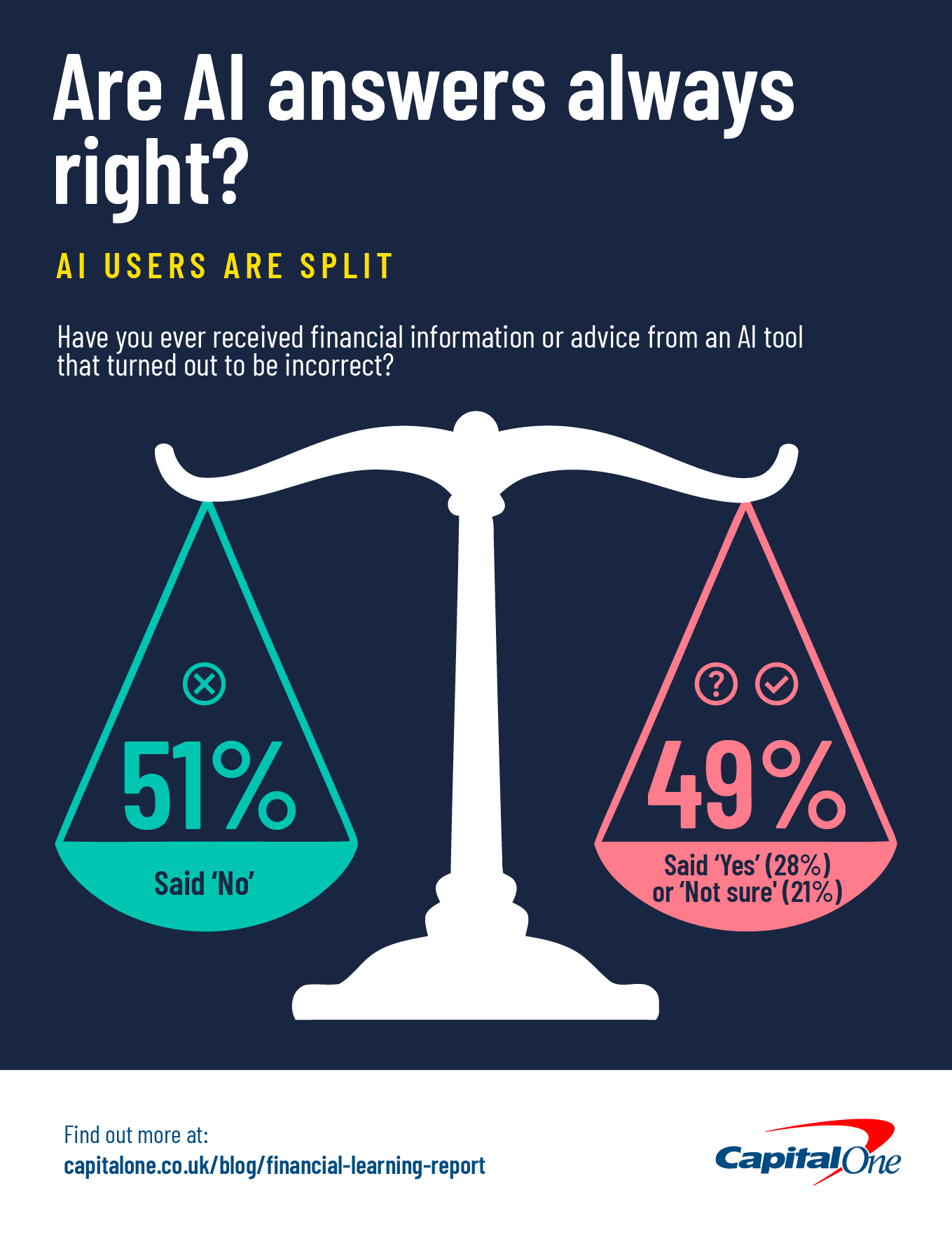
Users are split on AI’s accuracy: Half (51%) say they haven't received incorrect financial information or advice from an AI tool, while the other half (49%) either said they have (28%) or couldn’t be sure (21%).
About financial advice: Our survey used the term 'financial advice' as respondents commonly understand it - i.e., information and guidance on financial topics. This is distinct from regulated financial advice (opens in a new tab), which informs you which specific financial product would best suit your needs and can only be provided by somebody with a relevant financial qualification. Throughout this report, references to 'advice' reflect the everyday usage as understood by respondents.
Where do people learn about personal finance? Comparing lifelong and recent sources
To understand how learning about personal finance has changed over time, we compared people’s top three lifelong influences against the sources they used for advice in the past year. By providing a range of options spanning personal relationships, conventional institutions, and digital tools, we can see which sources played the biggest formative role in people’s financial learning and which have gained influence more recently.
Where people have learnt the most about personal finance over their lifetime
| Rank | Where have you learnt the most about personal finance over the course of your life? (select up to three options) | % of people |
|---|---|---|
| 1 | Parents | 37% |
| 2 | Banks or financial institutions (online and/or in person) | 31% |
| 3 | Search engines (e.g., Google) | 19% |
| 4 | Partner or spouse | 15% |
| 5 | Friends | 12% |
| 6 | Wider family (e.g., grandparents, siblings etc.) | 12% |
| 7 | Newspapers or magazines | 11% |
| 8 | TV or radio | 10% |
| 9 | Work or colleagues | 9% |
| 10 | Social Media | 9% |
| 11 | Books | 8% |
| 12 | Further education (e.g., College or University) | 6% |
| 13 | AI tools (e.g., chatbots, large language models (LLMs), and AI features in search engines like Google AI Overviews) | 5% |
| 14 | Podcasts | 4% |
| 15 | School | 4% |
| 16 | N/A - I haven’t learned about personal finance | 10% |
Our findings suggest that personal finance education is a patchwork of traditional and modern influences, heavily shaped by human relationships. Parents are the most influential source, providing lifelong learning for more than a third (37%) of people. When combined with partners (15%), friends (12%), and wider family members (12%), it becomes clear how habits and attitudes towards money are passed down through generations and shared within immediate social circles.
The data also shows a significant portion of people heading online to learn about personal finance. One in five (19%) people say search engines have been one of their main sources of lifelong learning, putting it in third place overall, with one in 10 (9%) people citing social media and one in 20 (5%) citing AI tools.
Banks or financial institutions (31%) were second overall and the most influential conventional institution on our list (ahead of both further education (6%) and schools (4%)). This shows they have an important role to play in providing a regulated source of information to help people make informed choices about their finances.
Where people have gone for personal finance information and advice over the last 12 months
| Rank | In the last 12 months, where, if anywhere, have you gone for personal finance information or advice? [Select all that apply] | % of people |
|---|---|---|
| 1 | Search engines (e.g., Google) | 28% |
| 2 | Banks or financial institutions (online and/or in person) | 23% |
| 3 | Financial advisors or professionals | 19% |
| 4 | Partner or spouse | 16% |
| 5 | Parents | 13% |
| 6 | AI tools (eg., chatbots, large language models (LLMs), and AI features in search engines like Google AI Overviews) | 13% |
| 7 | Friends | 12% |
| 8 | Social media | 9% |
| 9 | Newspapers or magazines | 9% |
| 10 | Streamed videos (e.g., YouTube) | 8% |
| 11 | TV or radio | 7% |
| 12 | Podcasts | 7% |
| 13 | Wider Family (e.g., grandparents, siblings etc.) | 7% |
| 14 | Work or colleagues | 7% |
| 15 | Books | 7% |
| 16 | Educational settings (e.g., school, college, university) | 4% |
| - | N/A - I haven’t looked for personal finance information or advice in the last 12 months | 30% |
Comparing these lifelong sources with habits over the past year, we see a shift towards digital tools. Search engines are now the most popular option (28%), easily ahead of parents (13%), who are as popular a source as AI tools (13%), despite their relative newness.
Banks or financial institutions hold their position as the second most common source, highlighting their ability to inform people’s long-term learning as well as their shorter term needs.
A closer look at those using AI for help with their personal finances
How often are they using AI?
Of those who have used AI for help with their personal finances in the past 12 months, more than a quarter (26%) are using AI tools at least once a day, rising to three in five (61%) who are using AI tools at least once a week.
| How often do you use AI tools for information or advice regarding your personal finances? | Regular AI Users* |
|---|---|
| More than once a day | 14% |
| Once a day | 12% |
| A few times a week | 27% |
| Once a week | 8% |
| Once or twice a month | 19% |
| Every few months | 13% |
| Once every six months | 3% |
| Once a year or less | 4% |
*Regular AI Users definition = people who said they have used AI tools for personal finance information or advice in the last 12 months
Who is using AI the most?
The data highlights a generational divide, with younger people more likely to cite AI tools as an important source in their lifelong learning as well as a tool they’ve used in the last 12 months.
| Generation | % citing AI tools as one of their top lifelong learning sources | % saying they've used AI tools for personal finance information or advice in the last 12 months |
|---|---|---|
| All | 5% | 13% |
| Generation Z (Born after 1996) | 8% | 15% |
| Millennials (Born 1981-1996) | 9% | 22% |
| Generation X (Born 1965-1980) | 4% | 11% |
| Baby Boomers (Born 1946-1964) | 0% | 4% |
Millennials are the biggest adopters on both fronts, followed by Gen Z, Gen X and then Baby Boomers. There are two reasons that could be driving this. Firstly, Millennials have spent their formative years navigating a series of digital shifts, from the advent of the internet, to the development of the modern smartphone and social media, so it’s possible they see AI as the latest in a long line of technological innovations to discover. Secondly, they’re also more likely to be at peak financial complexity than other generations, juggling things like mortgages, saving for retirement and the financial demands of a family, which would make quick and accessible support with financial planning highly enticing.
What are they using AI for?
So, what is AI being used for when it comes to personal finance? Our data shows it’s a real mix of use cases, including general advice; product comparison and information; educational use; and even personalised support.
This suggests that people see AI as a versatile tool for financial learning, whether that’s helping them, for example, to learn more about the different financial products on offer, to understand financial terms, or to help identify a possible scam.
| What they use AI tools for | Regular AI users* |
|---|---|
| For general financial advice** | 50% |
| To compare or research financial products (credit cards, bank accounts, etc) | 43% |
| For an explanation of financial topics or terms (e.g., APR, compound interest, etc) | 43% |
| To get information about the financial products I use (e.g., my bank account or credit card) | 37% |
| To ask questions about my current financial situation | 33% |
| To check if something might be a scam | 32% |
| To get help or advice on budgeting income and spending | 29% |
| To understand the financial impact of a life change | 24% |
| To summarise financial documents | 21% |
| To understand what affects my credit score | 19% |
| To understand how credit cards work | 15% |
| To understand how Buy Now Pay Later (BNPL) works | 13% |
*Regular AI Users definition = people who said they have used AI tools for personal finance information or advice in the last 12 months
**Our survey used the term 'financial advice' as respondents commonly understand it - i.e., information and guidance on financial topics. This is distinct from regulated financial advice (opens in a new tab), which can only be provided by a qualified professional. AI tools are not regulated to provide financial advice, and cannot legally guarantee the accuracy of product comparisons.
How accurate is the information they’re getting from AI?
When regular AI users were asked if they had ever received financial information or advice from an AI tool that turned out to be incorrect, the results were split: 51% said they hadn’t received incorrect information, while the other half (49%) either said they have (28%) or couldn’t be sure (21%).
While AI tools can make financial information more accessible, they may not always provide fully accurate or complete answers. This shows the importance of checking the information AI tools provide and cross-referencing with trusted sources, like your credit card provider’s website, when making financial decisions.
How perceptions of AI vary between those who use it and those who don’t
To explore broader perceptions of AI, we asked all survey respondents about their confidence in AI providing accurate advice or information, offering insights into how the general public feels about the trustworthiness of these platforms compared to regular users.
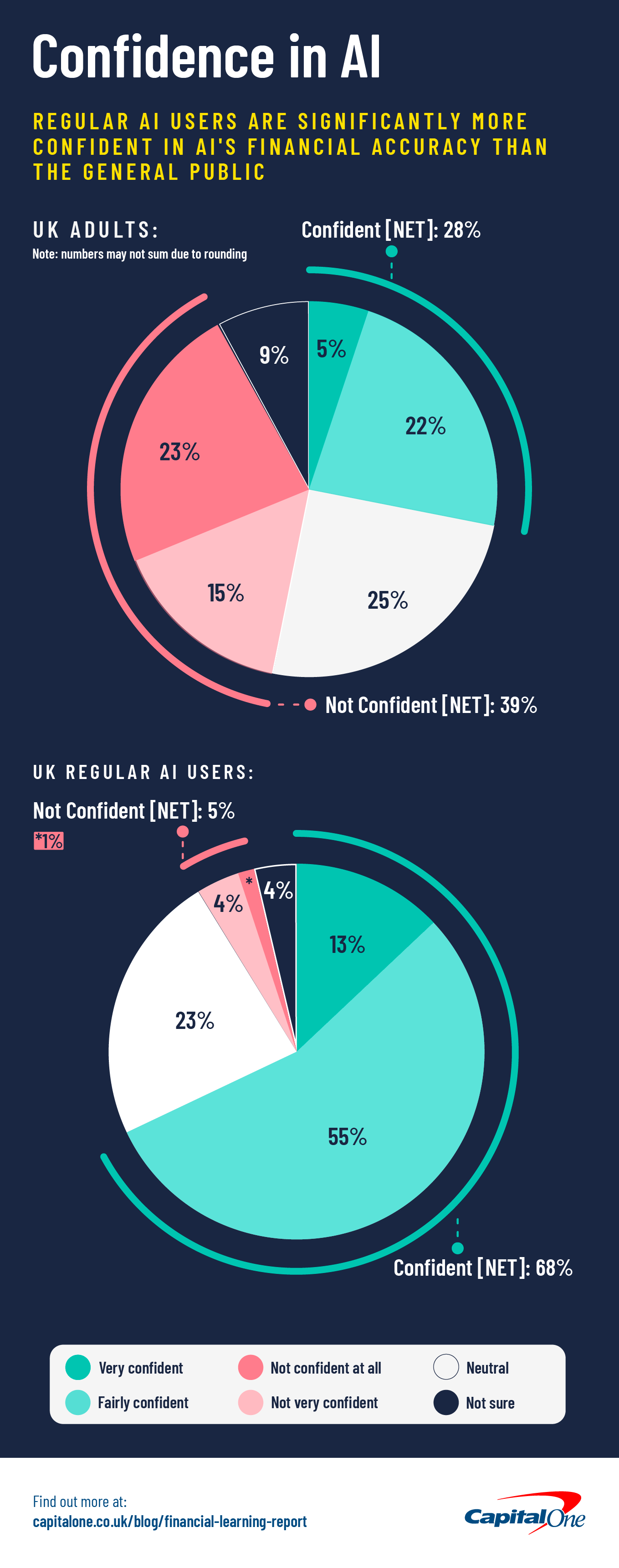
Among the general public, only 28% felt confident in its accuracy, compared to 39% who did not. However, trust among regular AI users was much higher, with 67% feeling confident and only 6% not feeling confident. As mentioned earlier, AI tools are not able to provide regulated financial advice, so this underlines the importance of always checking AI responses with trusted sources.
Confidence in the information these platforms provide is one thing, but how comfortable are regular AI users compared to the general public when it comes to sharing personal data with these tools?
| What personal information would you feel comfortable sharing with an AI tool? | % of Total Respondents | % of Regular AI Users* |
|---|---|---|
| N/A — I wouldn’t feel comfortable sharing any personal information with AI | 57% | 10% |
| My income range | 22% | 52% |
| My general spending habits (e.g., how often I shop, eat out, travel) | 21% | 55% |
| My saving habits or targets (e.g., how often I save/want to save, how much) | 21% | 57% |
| My typical monthly bills (e.g., rent, utilities, subscriptions) | 18% | 43% |
| My upcoming bills or payments | 13% | 32% |
| My credit score | 13% | 32% |
| My bank statement | 7% | 13% |
| My payslip | 6% | 9% |
| Screenshots or copies of transactions | 6% | 14% |
*Regular AI Users definition = people who said they have used AI tools for personal finance information or advice in the last 12 months
When it comes to sharing personal information with AI, comfort levels vary widely between the general population and those who have used AI recently. Among all respondents, 57% said they wouldn’t feel comfortable sharing any personal information, while around one in five would share their income range (22%), general spending habits (21%), or saving habits/goals (21%). In contrast, among those who have used AI in the past 12 months, only 10% wouldn’t share any personal information, and a majority would share their income range (52%), general spending habits (55%), and saving habits/goals (57%).
Sharing of more sensitive information shows a similar pattern: just 13% of the general population would share their credit score, compared with a much higher proportion of regular AI users (32%). Likewise, only 7% of all respondents would share a bank statement, 6% a payslip, or 6% screenshots of transactions, whereas these figures are notably higher among regular AI users, suggesting a greater willingness to share sensitive financial information with AI tools.
For security reasons, it’s important to think carefully about the personal information you’re sharing and who you’re sharing it with. The company’s privacy policy should explain how your data will be used and shared.
Conclusion: Should you be using AI for help with your personal finances?
From product research and budgeting support to explaining financial concepts, our research shows that AI is becoming a common source of financial information.
While AI can be a useful starting point, it's important to approach any advice or guidance with caution, verify the information you’re receiving and seek support from official financial sources.
At Capital One UK, we use AI tools ourselves and have seen first-hand both their potential and their limitations. As part of our commitment to being a force for good in lending, here are our two top tips for using AI tools confidently and responsibly:
Fact check AI responses with trusted sources - If you are using AI to help with your finances, make sure to fact check any information shared with official sites and sources. For example, if you’re asking AI for information about your Capital One credit card, always head to our website, app or contact us directly to verify the information you’ve received is accurate.
Be mindful of what you share with AI tools - You should always review the privacy policy of any AI platform before inputting any personal or sensitive information. If you’re using a free version of AI tools, you should be aware that your data may be used for training purposes.
How Capital One UK can help
If you’re looking for information about any of our products or need support with your personal finances, here’s how we can help:
Product information: Our product pages (opens in a new tab) have the most up-to-date and accurate information.
Help with your account: The quickest way to reach us is through your Capital One app, head to our contact us page (opens in a new tab) for more info.
To learn more about credit: We have information on a variety of credit-related topics on our Credit Blog (opens in a new tab) which aims to help make credit clearer, including what can affect your credit score (opens in a new tab) and our guide to first time credit cards (opens in a new tab).
Scam protection: For further information on how to spot scams, visit our scam problem page (opens in a new tab), where we provide support and resources to protect yourself against financial fraud.
Need more financial tips? Check out our other articles to learn whether you should use AI for help with your personal finances (opens in a new tab), understanding financial terms (opens in a new tab) and how to build your credit score with a credit card. (opens in a new tab)
Methodology
Capital One UK commissioned OnePoll to survey 2,000 UK adults (18+) in March 2026 to understand how they learn about personal finance and use AI tools. The survey looked at lifelong learning and recent habits, including where people go for advice or information about personal finance, what questions they ask AI, and what personal information they’d share.